


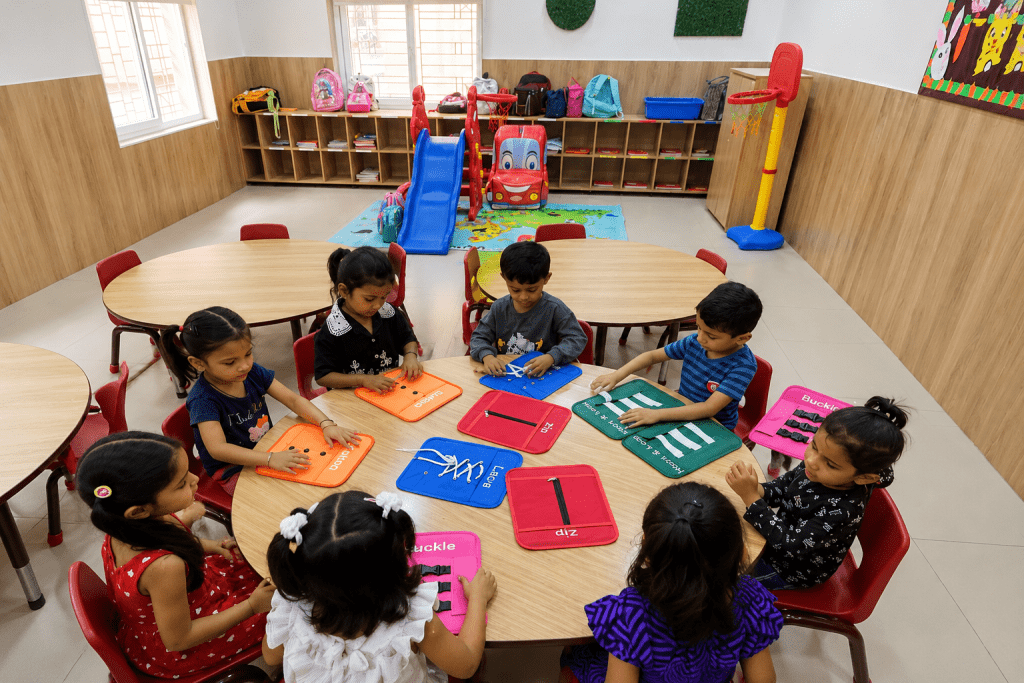
The Role of Extracurricular Activities in Shaping Young Minds
Extracurricular activities have always been of great help and of equal importance to academics in the Primary Schools in Nagpur in shaping children in order to make them more confident, social, creative and active. Although education begins with academic knowledge in primary school, Children should also be given chances to explore their own interests beyond the curriculum of lessons taught in the school. Sports, Music, Dances, Drama, Drawing, Public speaking, Storytelling and nature activities would help the child learn more through them.
Consequently, children also learn more on their own and develop communication, team work, confidence, creativity and leadership skills.
Also, Extracurricular activities make the school interesting. Activities should not be imposed, but chosen freely; this encourages children to come out more and express themselves freely with all other peers and accept challenges head on.
What Are Extracurricular Activities?
Extracurricular activities are learning experiences that happen outside regular classroom lessons. These activities encourage children to discover their interests while developing practical life skills.
Some common activities include:
- Music and singing
- Dance and drama
- Drawing and painting
- Sports and athletics
- Storytelling sessions
- Yoga and meditation
- Science clubs
- Nature walks
- Public speaking
- Art and craft
Each activity gives children an opportunity to learn through experience.
Why Are Extracurricular Activities Important in Primary School?
Children are often said to spend the most important stage of their development in primary school. They learn to build habits, process emotions, socialise with people, and shape their personalities during this age. So, academic grades are not the sole criterion to assess the importance of education given to the child.
Rather, schools must also allow them to communicate, cooperate, create, and explore or even try things out on their own.
Children engaged in numerous recreational activities usually have practical outlets for their school learning. If you are parent of Nagpur and are seeking for a good primary school, do keep those effective recreation programs in mind.
1. Builds Confidence from an Early Age
Most children will probably feel scared and hesitant when they have to stand in front of people, talk or perform something. Such situations get increasingly easy if the children have had opportunities to talk in front of others – to tell stories, perform on a stage, participate in a music concert or dance performance or deliver classroom presentations. Each success can be a boost for the child’s self esteem, helping him gradually build faith in himself and his capabilities.
2. Improves Communication Skills
So having some activities to speak, listen, express one’s ideas and understand someone else’s would be helpful for your child. When a child goes to participate in a drama, they must know how to express various emotion with their body or voice. When they have to tell a story, they can take time to think, plan how they are going to deliver the story.
3. Encourages Teamwork
Children must know the importance of teamwork, which is also a very important and needed skill nowadays.
In team sports or classroom activities or even group projects or even just dance competitions and play, you will always have to cooperate with your fellow members of the team.
Here they get opportunities to communicate with the rest of the team, listen to other, consider suggestions or opinions, fight and eventually find an amicable solution and agree together. They also come to realize that at times cooperation goes a long way in achievement, instead of focusing only on individual brilliance. These also become useful for their in future group projects or tasks and eventually workplace.
4. Supports Creative Thinking
As children are allowed to experiment and play with possibilities, creativity blossoms, which may help to inculcate it through activities like art, music, crafts, drama, model-building and creative writing. As an art activity may allow the students to select their preferred colour and design on the basis of their imagination and a drama class helps the child to conceive new characters, and in this way, with exploration in various areas children come to find multiple answers for a single problem and thereby it helps to broaden creative thinking.
5. Develops Leadership Skills
Leadership quality starts with various kinds of small responsibilities.
Like students may become group leader, captain, prefect, group coordinator, coordinator for some event, volunteer and so on.
For example, they get the opportunity to be responsible, they may get the chances for managing work in groups, understanding the need for listening to teammates and may lead. This practice of leadership skills in day-to-day work enhances their decision-making abilities, sense of responsibility and responsibility of managing things whether it goes well or wrong.
6. Improves Physical Health
Childhood is the age when a body is supposed to be agile; in the constant growth stage, movement for the body is essential. Sports, games, athletes, yoga and athletics prove highly beneficial for maintaining physical fitness.
Such games and athletes help to develop strength, stamina, balance, coordination and flexibility along with physical discipline.
Moreover, such school programs may help kids take a healthy break from academic pressure, and they may be able to refresh and concentrate during classroom activities. That is why most of the CBSE schools in Nagpur practice physical activity along with the academic syllabus.
Popular Extracurricular Activities in Primary Schools
| Activity | Skills Children Develop |
|---|---|
| Arts and crafts | Creativity and fine motor skills |
| Music and singing | Confidence and self-expression |
| Dance and drama | Teamwork and communication |
| Sports and games | Physical fitness and discipline |
| Storytelling and reading clubs | Language development and imagination |
| Science and nature clubs | Curiosity and problem-solving skills |
How Parents can foster involvement
Parents have the responsibility of helping children have fun when engaging in after-school activities. Rather than telling a child which activity to partricipate in, parents can provide oppurtunities for them to experiment and explore different activities.
A child may want to be artistic and experiment with drawing one month, and participate in various sports the next. By allowing them to experience a range of things children can really discover what their own interests are.
Reward effort, rather than just winning- The importance of the activity can be shown by acknowledging what and how the child played rather than the winning result of the activity. Parents need to realize that participation and personal improvement are just as important,if not more so,than winning.
Prevent comparisons- Children grow at their own speed, by comparing one child to another you can sometimes affect a child’s confidence negatively. The child can compare their performance with how well they did last time. In this way small increases feel like an achievement. Celebrating progress is another thing that inspires children to continue.
Maintain an everyday balance- Children’s needs and development can be met through other things, including academics, rest, family time and play, in addition to extracurriculars. The child’s day will not necessarily need to be completely full with many activities since there are many other aspects of growing up for them to enjoy.
Choosing the Right Primary School
Parents should look beyond academic results while selecting a school.
A good school offers:
Qualified teachers
Safe learning spaces
Sports facilities
Art and music programs
Interactive classrooms
Activity-based learning
Regular school events
Individual attention
Strong parent communication
Many families searching for the best school in Nagpur prefer institutions that encourage both academic excellence and overall personality development.
Common Myths About Extracurricular Activities
Although activities offer numerous benefits, it’s important to address common misconceptions about them. Here are some myths that do not quite apply when it comes to children and extracurricular activities.
Myth 1: Activities will take time away from my child’s studying.
Reality: Extracurricular activities that are well-balanced will not usually interfere with school work. Physical exercises and breaks in their creativity will also allow them to be more alert while they focus again on studying.
Myth 2: The only children that sports are beneficial for are those with talent.
Reality:Sports do not have to be for children aiming for competitions. Every child may benefit from exercises, unity and communication required during sports, discipline as well as from the entire bodily and mental effort.
Myth 3:Activities are solely for the entertainment of children.
Reality:Although play is part of every child’s extracurricular schedule, valuable life skills can be acquired by participating in certain activities. Drama may strengthen communication, sportmanship teamwork, and Art and Crafts creativity.
Myth 4: Academic learning alone is sufficient for children.
Reality: School knowledge matters greatly; however, children do require skills in terms of communication, self-assurance, adaptation, teamwork and solutions while facing various problems in life.
The Long-Term Benefits of Extracurricular Activities
The value of extracurricular participation extends beyond individual activities. Over time, children can develop a combination of social, emotional, creative, physical, and communication skills.
For instance, a child participating in a school theatre activity may improve communication while also learning teamwork and confidence. Similarly, a child involved in sports may develop discipline, coordination, resilience, and leadership.
In addition, regular participation encourages children to set small goals and work toward them. This process can teach patience and consistency.
Ultimately, these experiences contribute to the development of well-rounded individuals who are better prepared to handle new situations, build relationships, and take responsibility for their decisions.
FAQs
1. Why are extracurricular activities important in primary schools?
They help children build confidence, communication skills, creativity, teamwork, and emotional development while supporting academic learning.
2. Which extracurricular activities are best for primary school children?
Sports, music, dance, storytelling, art, yoga, chess, drama, and science clubs are excellent choices for young learners.
3. Do extracurricular activities improve academic performance?
Children develop better concentration, discipline, time management, and problem-solving skills through regular participation.
4. How often should children participate in extracurricular activities?
Two to four sessions each week usually provide a healthy balance between academics and personal development.
5. What should parents consider while choosing a school?
Parents should look for experienced teachers, safe infrastructure, activity-based learning, sports facilities, creative programs, and opportunities for holistic development.
Conclusion
Education is not only about classroom instructions and examinations. Children are learning through experience and participate, interaction, imagination, and discovery as well. Therefore extra activities will play a significant role helping children discovering their own talents and life skills.
Confidence, communication, cooperation, imagination, leadership, and discipline, and ability to bounce back, all would be increased when children participation in meaningful activities. All the above mentioned skills will not only benefited while children are studying at school, it also helps their journey to higher education and career path.
Knowing this, some parents who seek for a primary school in Nagpur consider extra activities as part of a quality education system. A balanced education setting that allows children learning, discovering, participates and grow with their own pace.
In conclusion, with the integration of studies and extra-curricular activity, a child would be trained better to grow into a competent learner, a responsible individual, and a confident citizen.
