Best Nursery School in Nagpur Where Learning Comes to Life
A child’s early years are full of curiosity and discovery. Play-Based Learning in Nursery School gives children a natural way to explore and learn. They can move, ask questions, try new things, and share their ideas. Therefore, learning becomes more enjoyable and meaningful.
Young children need space to experiment and understand things at their own pace. They learn through movement, imagination, communication, and interaction. For this reason, a purely formal teaching approach may not always work well at the nursery level.
Teachers can use simple play activities to support language, thinking, motor, social, and emotional development. For example, children can learn through building, drawing, storytelling, sorting, and group games. As a result, they understand new ideas through experience instead of simply memorizing facts.
Today, many parents in Nagpur look for schools that make early learning active and enjoyable. Some of the best nursery school in Nagpur use play- based activities as part of their daily classroom learning. This approach can support holistic development while helping children develop a positive attitude towards learning.
Learning Through Play in the Early Years
Play-Based Learning in Nursery School helps children gain knowledge and skills through meaningful play activities. Although an activity may look simple, teachers can plan it around a specific learning goal.
For example, a child building a block tower is learning more than how to stack toys. The activity can introduce ideas such as shape, balance, size, measurement, and numbers. If the tower falls, the child can try again and find a better way to build it.
Pretend play offers another useful example. Children may act as shopkeepers, doctors, teachers, or parents. During these activities, they use new words, create stories, solve simple problems, and interact with others. In this way, Play-Based Learning in Nursery School can support communication, imagination, reasoning, and social skills.
Another benefit is that children get opportunities to make their own choices. They can decide what to build, which role to take, or how to complete an activity. Moreover, this freedom can help them become more confident when sharing ideas and trying something new.
The Power of Play-Based Learning in Nursery School
Young children naturally want to move, explore, and try things for themselves. Play-Based Learning in Nursery School gives them the freedom to do this while learning important skills.
Through play, children can learn from mistakes without feeling judged. If an activity does not work the first time, they can try again. Therefore, play can help develop patience, problem-solving, and confidence.
Group activities also teach children how to interact with others. They learn to share, take turns, listen, and follow simple rules. At the same time, they become more comfortable expressing their thoughts and feelings.
Play-Based Learning in Nursery School also gives children a chance to practise the same skill several times. For example, a child may repeat a puzzle, drawing activity, or movement until they become more comfortable with it. With regular practice, their confidence and ability can improve.
Most importantly, Play-Based Learning in Nursery School makes early education active and enjoyable. Children do not simply receive information from a teacher. Instead, they take part in the learning process through exploration, communication, and discovery.
Finally, Play-Based Learning in Nursery School can help children develop a positive attitude towards education. When children enjoy learning, they are more likely to remain curious and engaged as they move into the next stages of school.
Growing Young Minds Through Play
All-round development refers to support in various fields, as against providing only the academic knowledge. Hence, play-based activities may provide support in physical, cognitive, social, emotional, creative and linguistic development:
1. Cognitive Development
Children are constantly making decisions through play. They compare objects, identify patterns, remember instructions and solve problems.
For example, games like puzzle, encourage logical thinking, while sorting games introduce concepts like color, size, classification. Similarly, building blocks help children understand relationships between objects.
As they encounter minor challenges, they learn to think and act on their own. Gradually, this might boost concentration, rationale and problem-solving abilities.
2. Physical and Motor Development
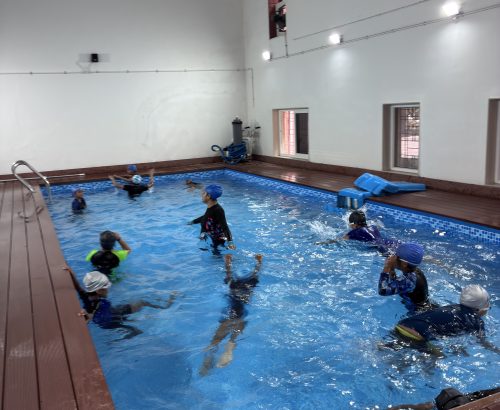
Movement is fundamental to early childhood. Thus, activities like running, jumping, balancing, stretching and coordination of movements are included in preschool.
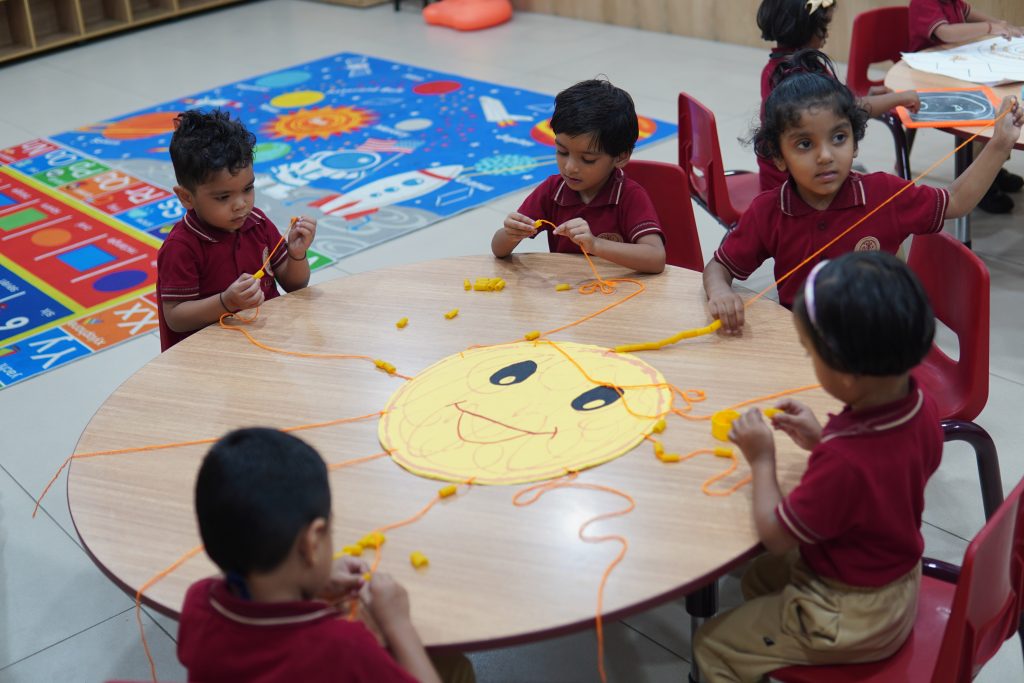
Outdoor games, obstacle courses, dances and simple sports provide gross motor development. Drawing, coloring, clay modelling, threading and puzzles stimulate the fine motor skills.
With enjoyable activities children develop physical strength, balance and coordination skills.
3. Language and Communication Skills
Play is also one of the natural medium where the child begins to communicate with others.
Through dramatic play children pretend to be a doctor, teacher, shop keeper, parent or a chef. In this the child learns new words and sentences. Similarly storytelling games motivate children to describe characters, events and emotions.
Group games teach the children the art of listening to others, and speaking to them with clarity.
With the playful approach the communication skill can be better without the child feeling intimidated.
4. Social Development
Social skills are built from playing with others. Hence group play offers the chance for young children to develop social skills from a young age:
For example children may be taught taking turns, sharing, following instructions and cooperating with friends. Arguments can be dealt with on how to communicate with others in a respectful way and solve problems with mutual agreement.
Games taught collaboratively can lead children understand that people can have different ideas that can be understood. This may help to develop empathy, perseverance and teamwork.
5. Emotional Development
The young child is learning to cope with, understand and express his emotions. Play time is a safe place for him to experiment:
Feelings like happiness, fear, excitement, frustration and others are learned by the child in stories, puppets play, dramatic play or any creative pursuit. With this he can also better articulate what he is feeling.
Completing of games may also lead to the child feel he has succeeded in something. Thus it enhances self-belief, independence and emotional well-being.
6. Creativity and Imagination
Creativity progresses when children are not given definite answer to respond with. Hence open-ended play is the key for nursery kids:
A box can turn out to be a car, a blanket could take shape of a tent while a few blocks can form a whole imaginary city. In such activities children create there own ideas rather than following others directions.
Through art, music, dance, stories, drama other ways to express can take various shapes. Thus imagination could prove the most integral part of their learning journey.
Kinds of Play-Based Activities at Nursery School
By providing a range of play activities, a good nursery environment allows children to participate in various types of learning activities.
1). Block and Construction Play- Through building block activities children are exposed to various shapes, sizes, concept of balance, patterns and spatial awareness. Also it enables children to collaborate and work together on constructing a building which promotes social learning.
2). Story-Telling and Role-Playing- Story-telling allows children to listen, imagine and also to express. Role-play enables children to imitate activities. For instance, children will enjoy dressing up as different characters such as doctor, customer, teacher, etc., and play simple games such as going for shopping, visiting a doctor, etc. These experiences enhance vocabulary in children’s minds while making it easier for children to understand daily routines in the classroom and community.
3). Art and Craft Activities- Activities like coloring, painting, drawing, work on paper activity or clay modeling stimulates creativity; simultaneously they build fine muscle skills and coordination. Rather than the expected ‘product’, the focus can be made on children to narrate their creation, which can bring in additional opportunities for language development.
4). Outdoor Play- Outdoor play gives sufficient space and freedom for children to move. Therefore at nursery schools, playground games, running games, balancing games and small-scale obstacle courses, etc, can be beneficial for developing gross physical skills. Children also observe various aspects of nature, for example, it can be flowers, leaves, insects, weather changes, sounds, etc. This can lead children to ask and wonder about the things around them.
5). Music and Movement Play- Songs, rhythm games, dancing or music with active response promotes various skills in addition to memory and language, such as fine muscle skills through active participation while listening to rhythms, coordinating body movements and following directives. Music also ensures the classroom is livelier and offers children who might be reserved more encouragement to join in.
Creating Spaces Where Children Love to Learn
When teachers use play as part of instruction there is not just free play with kids around all day long.
Play-based learning means planning teacher-led activities within a purposeful learning environment around development goals.
For example, a teacher might use a counting game or activity to build children’s number identification, although it does not take form in simply memorizing numbers but, hands on, using manipulative objects, or by integrating other concepts like colors using toys and blocks in the classroom.
Playing store allows teachers to integrate language, math, social interactions, colors, etc. In essence, teachers become facilitators. They observe, ask guiding questions, encourage participation, and present challenging problems as each child is ready for them.
Building Better Learning Experiences for Children
The success of a play based curriculum involves creation of a nurturing environment. In the nursery classes, children will also have protected areas where he/she can be at rest, freely move, interact with his peers, construct as well as play.
The following spaces can be organized into several learning corners based on the following : Learning area on reading, art area, construction, fantasy play, jigsaw puzzle zone as well as areas with sensory exploration activities.
The materials can be organized such that children are able to make limited choices.
The environment should be such that the children do not feel fear of committing mistakes. Teachers should promote an atmosphere in which mistakes are encouraged and treated as a normal outcome of learning experience.
Creating the Right Environment for Young Learners
As opposed to just worksheets and routine learning, while choosing a nursery school parents must keep in mind to pay attention to the way the school nurture and support the holistic development in their tiny tots. An optimal play school environment might typically have:
i). Appropriate play based activity and programs
ii). Secure indoor and outdoor play areas
iii). Avenues for children to explore their creativity
iv). Language and storytelling sessions to improve their vocabulary
v). Interactive and stimulating learning materials
vi). Team-based cooperative activities
vii). Fine and gross motor activities
viii). Encourage questions and promote curiosity in kids
ix). Welcoming and positive classroom ambience.
x). A combination of led and free play as a healthy blend.
Apart from this parents may also enquire about assessment procedures in relation to the progress and development in the nursery. In the nursery stage development should be more in the sense of expression communication confidence participation creativity Coordination and co-ordination and social adjustment. Therefore when contemplating options, keep in mind, do the best nursery school in Nagpur to offer children the platform to develop through creativity and experience exploration.
Getting Children Ready for School Through Play
Through play-based activities, children naturally learn how to listen, follow instructions, communicate, complete tasks, solve problems, share, cooperate, and negotiate with others. These skills help children become more confident, attentive, and comfortable in a classroom environment.
For example, when children participate in group games, they learn to take turns, follow rules, listen to others, and respond appropriately. Similarly, when children create stories through imaginative play, they develop their creativity while learning how to express ideas, listen carefully, and communicate with their peers.
Moreover, play encourages children to explore, make decisions, overcome challenges, and learn from their experiences. As a result, they gradually develop the social, emotional, cognitive, and communication skills that support a smooth transition into formal schooling.
Therefore, play-based learning is much more than entertainment—it is an important foundation for school readiness and lifelong learning. By giving children opportunities to learn through meaningful play, we help them enter school with greater confidence, curiosity, independence, and enthusiasm for learning.
Conclusion
To young children, it’s far more than simple amusement. Play is a potent learning instrument that can stimulate a child’s physical, cognitive, language, emotional, social and creative growth and learning. Nurseries can encourage children to grow without pressure while learning as they move, think, create, imagine, speak and work together with gentle care and guidance.
As such children discover something without being asked to absorb difficult information and they can engage actively in their own education through the process of their day-by-day interactions and activities.
Ultimately it’s important that children feel secure enough to share new ideas, ask many questions and be permitted to err without fear. By balancing learning and play opportunities skillfully, we help make childhood fun and at the same time make it a productive educational ground for lifelong learning and growth. Selecting an ideal early education center by determining the best nursery school in Nagpur will make a profound impact on allowing your little one to bloom while benefiting from their day of fun.